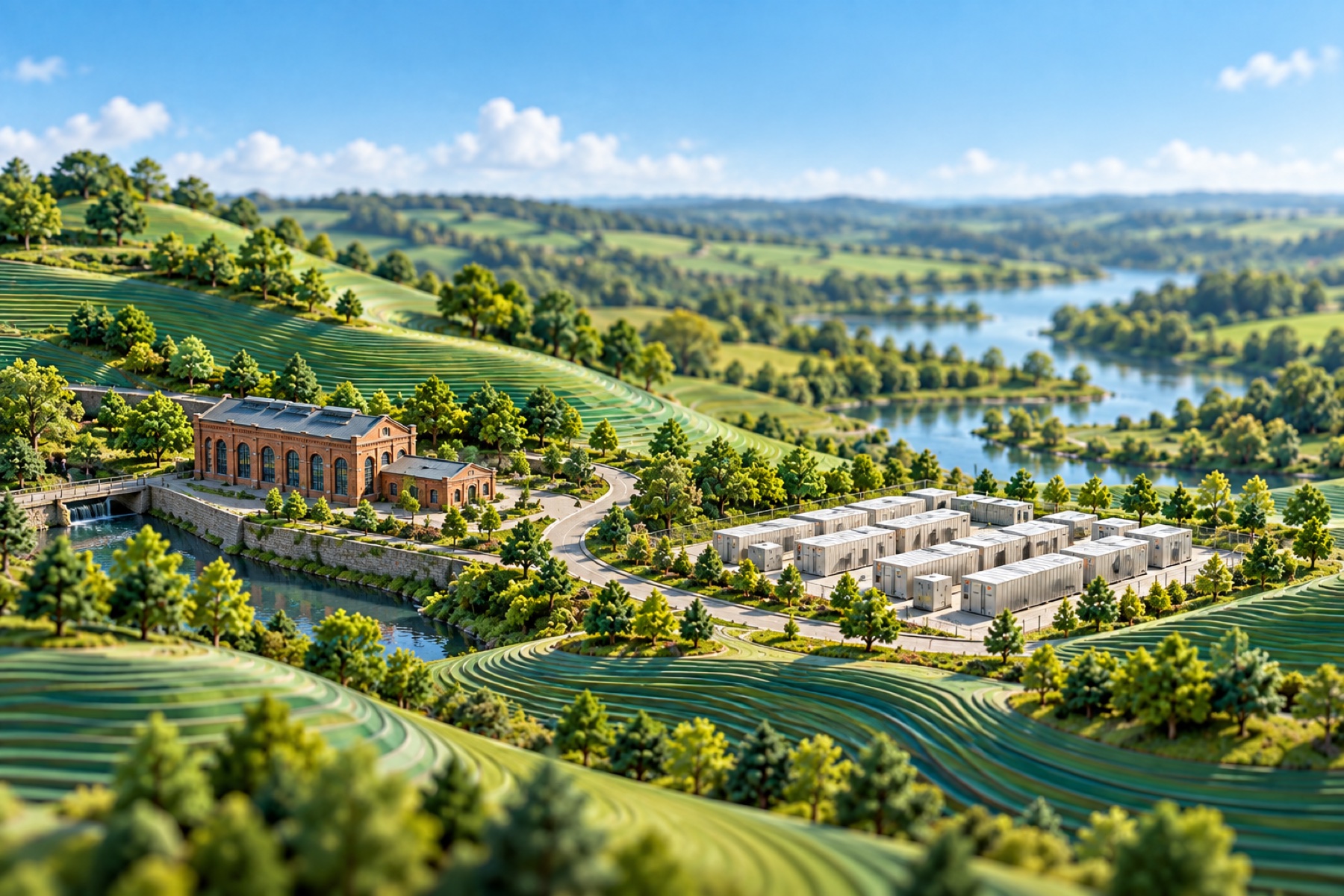

I think about this a lot and it’s not just a cheaper power bill.
Cheap and abundant power changes the world more than most can imagine.
In this post, I’ll show you a realistic path to how we get to cheap and abundant electricity and how that will actually change the world.
My bet is that we get there in 10–15 years in the US.
Solar, wind, and battery storage are the keys.
Once built, this infrastructure produces clean electricity with no inputs (oil, gas, coal). The sun is free and is all that’s needed.
Here’s why this can realistically happen:
Solar and wind are now the cheapest way to build new power plants in most of the world. Not “one day”. Today.
The cost of electricity from big solar farms has fallen 80–90% in about 15 yrs. In many places, new solar already makes power for about 3 to 5 cents per kilowatt hour w/o any subsidies.
Battery storage has done the same thing.The cost of large battery projects has dropped by roughly 90% since 2010. This technology is rapidly expanding across the country (which is why I started Sunland America).
At the current pace, it’s very realistic that by the mid-2030s we’ll see:
solar farms making electricity for 2 to 3 cents per kilowatt hour in many sunny regions
batteries cheap enough that “solar plus batteries all day and all night” are still cheaper than new coal or gas
Solar is still compounding. Solar electricity supply has been roughly doubling every 3 years or so.
We just crossed more than two thousand terawatt hours of solar generation per year. With a couple more doublings, it will be the dominant source of energy generation. Every doubling reduces the cost to produce new solar by about 20%.
This is not just an environmental story. It’s the cheapest technology, quickest to deploy, and is renewable.
Quick side note: When your electricity generation is renewable (like solar or wind), you’re no longer digging up stuff and burning it to make electricity. Once a solar or wind facility is built, it produces electricity for 25+ years with no inputs.
When electricity gets this cheap and abundant, a bunch of “too expensive” ideas suddenly become possible.
Let’s talk about a few of these categories that all could change the world:
– Fresh water becomes abundant
Desalinating seawater into fresh water is basically a question of how much electricity you are willing to throw at it.
When power is cheap in the middle of the day, coastal cities can turn sun into water, then store the water in tanks and aquifers instead of trying to store every electron. Drought eventually becomes a world we rarely say.
– Materials become “solid electricity”
Aluminum, steel, and other metals are just energy in solid form.
If your cost of electricity drops far enough, you can:
Run electric furnaces instead of coal
Place smelters right next to giant solar and battery farms
Treat clean metal as a default building block for cars, buildings, robots, and infrastructure
– Fuel is no longer just dug from the ground
We can use cheap power to produce green hydrogen. This cleans up some of our biggest polluting industries by producing:
clean fertilizer
clean shipping fuel
cleaner aviation fuel
With cheap and abundant electricity, we won’t be stuck with burning diesel or jet fuel for our heavy industries.
– Climate repair moves from fantasy to reality
Pulling CO2 out of the air is energy hungry. It’s possible now, but as long as electricity is expensive, removing carbon dioxide is insanely expensive.
As electricity gets cheaper, this actually becomes realistic. When you combine that with rapid advances in carbon capture technology, it’s possible this could be a real solution to our climate crisis.
– AI and robots will improve our quality of life
AI is transforming the digital world and robots will transform the physical world. Both will need cheap and abundant electricity in order for society to flourish.
AI will radically improve education, health care, life span, technological advancements in all fields, governance, and more.
Robots will replace physical labor and allow us to have an abundant, efficient, and cheap service economy. Work can be optional in a world of abundant intelligence and physical labor.
This AI and robotic future is not possible without abundant power.
– Housing and communities change
Imagine new neighborhoods where:
Every home is heated and cooled by efficient electric systems
Millions of solar panels are quietly producing electricity during the day
Shared batteries in the community soak up excess solar power and keep the lights on at night
Vertical farming can produce quality food close to where we live
Developers design new communities around energy abundance to provide a great place to live.
– Cheaper goods and services
Electricity is a major factor in the cost of all goods and services.
When power is cheaper, all goods will be cheaper. Every component of every good made has a line item for power. If power was drastically cheaper, all goods and services in the world would cost less to produce.
So when do we feel energy abundance?
My thoughts:
In very sunny, wealthy regions, we start to feel it in the 2030s. There will be long stretches of the day where electricity is so cheap it is almost an afterthought for many uses.
In most advanced economies, we feel it in the late 2030s and 2040s, if we keep building solar, wind, storage, and transmission at today’s pace.
Globally, it comes down to finance, permitting, and political will. The hardware is already cheaper than fossil fuel plants in most places.
In the US, the bottleneck is how fast we can connect to the grid and how much will our current government try to hold us back from these technologies (a topic and post for another day).
This is no longer a technology problem.
We do not need a miracle battery (although they are getting radically cheaper and denser every year).
We don’t need a new renewable energy technology. Solar and wind technologies already exists and are getting cheaper each year.
We mostly need:
To keep scaling the manufacturing of solar panels and batteries
To build more distribution and transformers
To realize that fossil fuels are not our future. They are a bridge for our transition to renewable energy which is cheap and clean.
Cheap, abundant electricity is the base layer of abundance itself.
With it, we get:
Water security
Cleaner and more flexible industry
Faster and cheaper computing
More comfortable housing
More resilient food systems
A real shot at cleaning up the atmosphere
There is a real path where this can happen.
As a society, if our core focus is to build cheap and abundant electricity, it will provide the foundation for a society with true abundance. If we can pull this off, the downstream effects will change our lives.
View an Interactive App Here on this subject.