
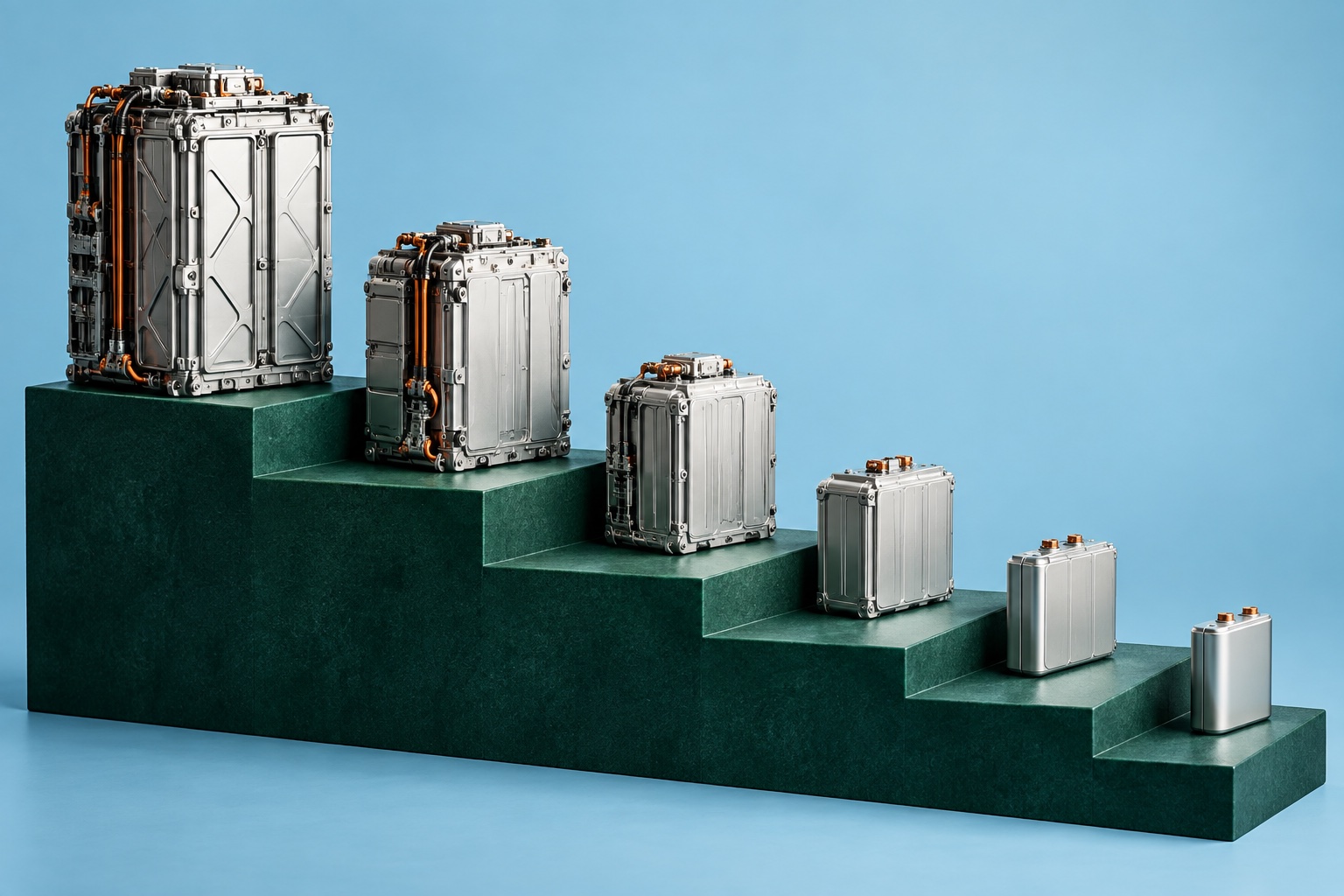
Think back to the first flat-screen TV you ever saw. It cost a fortune, weighed a ton, and colors looked a bit strange. A few short years later the same size screen was half the weight and half the price. Utility-scale batteries have followed a similar track, only faster. These giant battery packs, each one able to power a town, have tumbled from ultra-premium gadgets to everyday gear in less than a decade.
Below is a plain-English tour of how that cost crash happened, why it keeps going, and what it means for grid builders like Sunland America.
Price drops you can see
Year | Typical installed cost* |
2015 | $2,150 per kWh |
2018 | $ 625 per kWh |
2024 | $ 334 per kWh |
2024 pack only | $ 115 per kWh |
2035 (mid-case est.) | $ 250 per kWh |
2035 (low-case est.) | $ 150 per kWh |
*Installed cost means every bolt on the job: battery packs, racks, inverters, wiring, concrete, labor, and profit.
The numbers tell a clear story. In just three years, average U.S. prices plunged nearly seventy percent, and momentum has not slowed. Hardware makers now expect another forty to fifty percent cut by the mid-2030s if current trends hold.
Six big forces pushing prices down
1. Factory scale
Gigafactories across Asia, Europe, and North America turn out battery cells by the terawatt-hour. Large plants spread fixed costs thin, so each new batch rolls off the line a bit cheaper. In 2024 global cell capacity briefly ran ahead of demand, and sellers trimmed prices to keep production humming.
2. A swap in chemistry
Early grid systems leaned on nickel-manganese-cobalt (NMC) chemistry. NMC gave good energy density, but nickel and cobalt are pricey and come from uneven supply chains. Lithium-iron-phosphate (LFP) cells replace those metals with abundant iron and phosphate, cutting raw-material risk and insurance bills tied to fire safety. Today LFP is the default choice for most stationary projects.
3. Learning by doing
Every doubling of installed capacity teaches builders new tricks—how to pour concrete pads in half the time, how to run fewer copper cables, how to cool containers with smaller HVAC units. These tweaks shave minutes, parts, and dollars from each install. Design software improves too, letting engineers avoid over-sizing racks or footings.
4. Cheaper ingredients
Lithium carbonate and other active materials spiked in 2022, but new mines and recycling plants soon eased the pinch. Prices for graphite, copper, and aluminum slid as well. Because raw materials make up most of a battery’s price tag, even small commodity drops ripple through finished costs.
5. Smarter software
A modern site uses algorithms to chase the best revenue every few minutes. The battery may soak up solar at noon, then steady grid frequency at three, then sell power at seven. More cash per megawatt-hour means a project can hit its profit target with less hardware. Fewer cells create a smaller, cheaper plant.
6. Policy support at every level
Federal tax credits, state rebates, and utility competitive-procurement rules all grease the cost slide. Credits lower the effective price, and bulk orders placed to capture those credits let suppliers grant volume discounts. Domestic-content bonuses in the United States and Europe also nudge companies to open local factories, which cuts freight and currency risk.
Why falling costs matter
Cleaner evenings
Batteries paired with solar stretch sunlight into suppertime. In sunny regions the combined cost now beats or matches a new natural-gas peaker plant. That flips the old rule that solar was cheap only while the sun shone.
Faster project timelines
A battery plant can be built in under two years, often on the site of an old coal yard or next to an existing substation. Lower prices make small, modular builds pencil out in rural counties that once looked too risky.
New revenue tricks
Cheaper hardware opens profits in once-niche services: jump-starting power plants after blackouts, backing up data centers, or easing transmission bottlenecks during storms. Stacking three or four revenue streams tightens payback times even more.
Stronger climate targets
States and countries tying carbon-free goals to specific dates need flexible power sources. Battery storage levels the ups and downs of wind and solar, letting regulators push renewable targets higher without raising retail rates.
How low can it go?
Forecasts vary, but most analysts expect at least a gentle drop each year through 2035. A three-percent annual decline may sound small, yet compounding turns that into a twenty-five percent cut over a decade. A few headwinds could slow progress:
Trade tension could lift tariffs on imported cells or metals.
Mineral bottlenecks might return if electric vehicle demand jumps faster than mining can keep up.
New chemistries like sodium-ion or flow batteries require fresh factories and supply chains before they enjoy their own learning curves.
Even so, no single factor looks strong enough to reverse the overall trend. Most observers expect utility-scale storage to stay on a cost glide path that outpaces inflation.
Final thought
In 2015 these big batteries were niche science projects. By 2024 they had fallen below the cost of many fossil-fuel alternatives, and by 2035 they could be even cheaper than building new gas turbines in most regions. Factories keep scaling up, engineers keep trimming waste, and new chemistries keep arriving. If the past decade is any hint, the battery that powers your town tomorrow will cost only a fraction of today’s model. That is good news for developers, ratepayers, and the planet alike.
Sources
U.S. Energy Information Administration, “Utility-scale battery storage costs decreased nearly 70% between 2015 and 2018,” Today in Energy https://www.eia.gov/todayinenergy/detail.php?id=45596
National Renewable Energy Laboratory, Cost Projections for Utility-Scale Battery Storage: 2025 Update https://docs.nrel.gov/docs/fy25osti/93281.pdf
BloombergNEF press release, “Lithium-ion battery pack prices drop to record low of $115 per kilowatt-hour,” Dec. 10 2024 https://about.bnef.com/insights/commodities/lithium-ion-battery-pack-prices-see-largest-drop-since-2017-falling-to-115-per-kilowatt-hour-bloombergnef/
NREL, Annual Technology Baseline 2024: Utility-Scale Battery Storage https://atb.nrel.gov/electricity/2024/utility-scale_battery_storage
Lazard, Levelized Cost of Energy+ 2025 https://www.lazard.com/media/eijnqja3/lazards-lcoeplus-june-2025.pdf
Reuters, “Europe’s renewables market powers battery storage boom,” Feb. 6 2025 https://www.reuters.com/business/energy/europes-renewables-market-powers-battery-storage-boom-2025-02-06/
Reuters, “Sodium-ion set to impact thriving US battery market,” Oct. 3 2024 https://www.reuters.com/plus/acumen/vision-2045/vianode-sustainable-battery-materials