
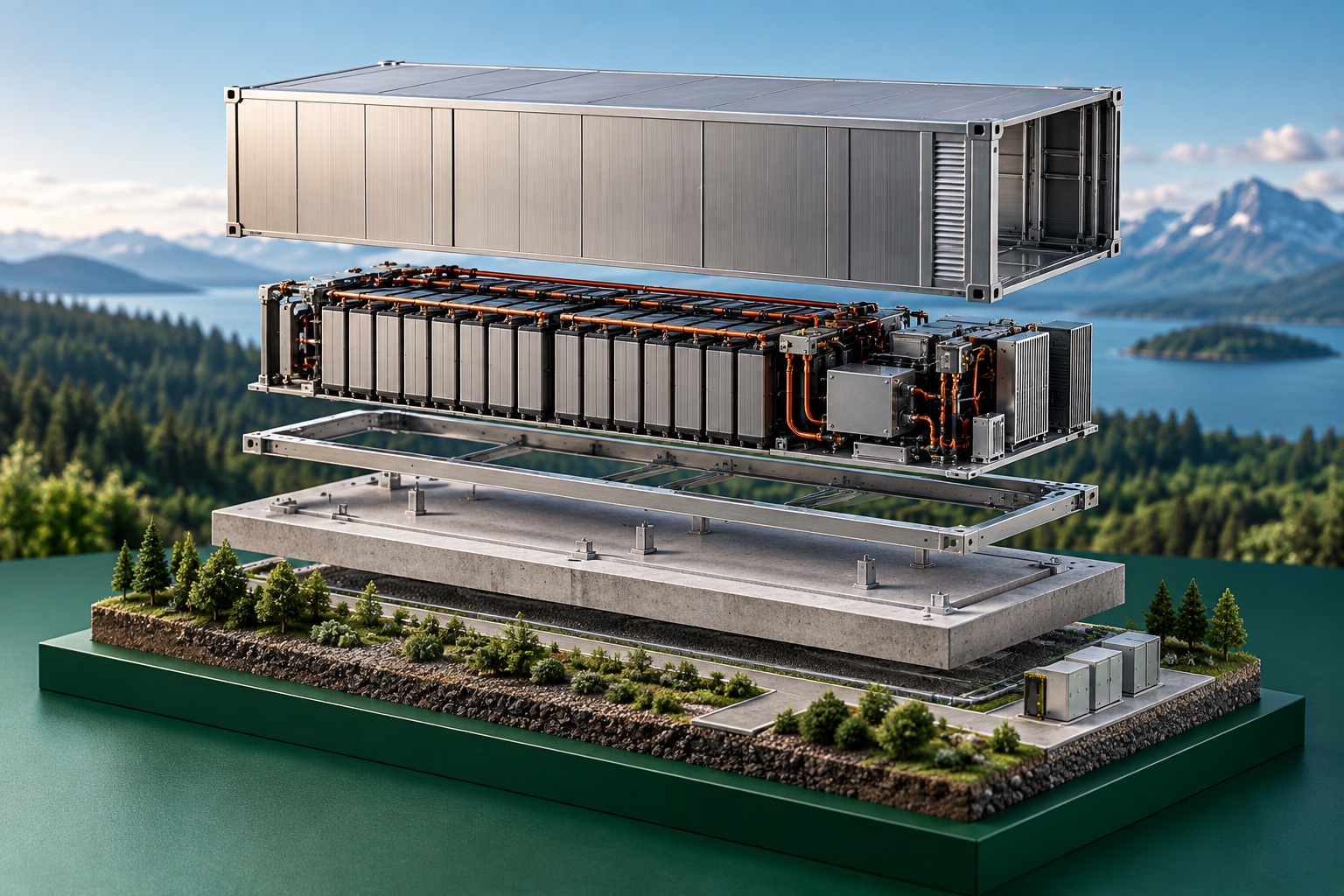
Big batteries are getting cheaper, but they are not cheap. If you plan to build a 100-megawatt (MW) four-hour project this year, you still face a nine-figure price tag. This guide breaks that number into plain parts so you can see where the dollars go and where you can save. We use the latest 2025 benchmark data from NREL, BloombergNEF, Lazard, and other public sources.
The Quick Snapshot
Pack price (cells plus casing): ≈ $115 per kilowatt-hour (kWh)
All-in installed price for a 4-hour system: ≈ $320-$360 per kWh
Typical project budget
100 MW / 400 MWh at $340 per kWh ≈ $136 million
Fixed O&M: about $6 per kW-year
Variable O&M: about $3 per MWh cycled
Numbers shift by state, supplier, and interconnection needs, but these are the rough center of the market in mid-2025.
Why Pack Cost Is Only Half the Story
Battery packs grab headlines, yet they make up a little over half of total spending. A recent NREL bottom-up model for a four-hour plant shows where the rest hides:
Battery cabinets (cells, racks, safety gear) – about 60 percent
Power electronics (inverters, transformers) – 15 percent
Structural and electrical balance of system – 10 percent
Installation labor – 4 percent
Soft costs (permits, interconnection studies, project insurance) – 4 percent
EPC overhead, contingency, and developer profit – 7 percent
Cutting cell prices alone will not halve project cost. Developers who also squeeze balance-of-system (BOS) and soft costs see the biggest wins.
Cost by Storage Duration
The longer the battery runs, the lower the cost per kWh, even though the full project bill rises.
Duration | Installed cost range (2025) |
2 hours | $410-$460 /kWh |
4 hours | $320-$360 /kWh |
6 hours | $260-$300 /kWh |
8 hours | $220-$260 /kWh |
Most U.S. markets reward four-hour systems, so that line still sets the standard budget.
Soft Costs That Sneak Up
Interconnection upgrades
Cluster-study fees run $80,000-$120,000 up front.
Network upgrades can add $40-$120 per kW if a new substation bay or breaker is required.
Sales tax and duty
Sales tax averages 2-8 percent of hardware, depending on county exemptions.
Imported LFP cells pay general duty of 3.4 percent. Section 301 tariffs may lift that to 11 percent.
Environmental and fire code compliance
Third-party lab testing and on-site fire suppression add $2-$6 per kWh.
EPC overhead and contingency
Most lenders insist on 10 percent combined.
Construction Timeline and Carrying Costs
A 100 MW battery usually spends 14-18 months from notice-to-proceed to commercial operation. Carrying interest during build can add 3-4 percent to the capital stack, especially with today’s rates near 7 percent for construction debt. Locking equipment early reduces price risk but may increase warehouse fees, now around $1 per kWh per month for climate-controlled storage.
O&M and Augmentation
Fixed O&M covers routine checks, security, software, land rent, and augmentation reserves.
Most budgets set $6-$8 per kW-year.
Variable O&M pays for dispatch scheduling, energy usage fees, and small state of charge losses.
Common figure is $3-$4 per MWh.
Augmentation means swapping in fresh modules to keep capacity steady. Plans allocate 5-8 percent of capex across years 7-12. Factories now sell drop-in LFP replacements that slide into 30-minute service windows.
Case Study: West Texas Four-Hour Build
Item | Cost ($ million) |
Battery cabinets (400 MWh) | 78 |
Inverters and transformers | 18 |
Structural BOS | 10 |
Electrical BOS | 8 |
Installation labor | 5 |
Soft costs (permits, studies) | 4 |
Sales tax & tariffs | 3 |
EPC overhead & contingency | 6 |
Developer fee | 4 |
Total EPC | 136 |
Land lease and construction interest push the “all-in” spend to about $145 million. After a 30 percent Investment Tax Credit, plus a 10 percent domestic-content bonus for U.S. inverters and racks, net equity need falls near $95 million.
Five Ways to Trim the Bill
Design one-hour blocks first – Order the inverter skid for full power, then add energy modules in phases. This spreads cash over two years without killing tax credit rules.
Pick domestic racks and inverters – U.S. steel and power electronics can unlock a 10 percent IRA bonus worth millions.
Share an interconnection – Co-locate with a solar plant or another battery to split study and upgrade costs.
Use prefabricated pads – Precast concrete skids shorten civil work by weeks and cut structural BOS by up to 15 percent.
Negotiate augment pricing at award – Lock a future unit price for replacement modules to curb inflation shocks.
Cost Outlook Beyond 2025
Analysts still see a gentle glide:
Pack prices falling 3-5 percent per year as LFP edges lower and sodium-ion lines open.
Installed prices dropping slower, about 2-3 percent per year, since soft costs shrink more slowly.
A mid-case NREL path points to $243 per kWh for four-hour systems in 2035.
Trade spats or mineral crunches could slow the slide, but new gigafactories in Michigan, Georgia, and Texas give supply security a boost.
Bottom Line
A utility-scale battery in 2025 still costs more than a downtown office tower on a per-pound basis, yet each year chips away at that figure. Developers who understand the true cost stack – packs, electronics, BOS, soft costs, and financing – will spot savings that others miss. Plan early, lock bonuses, and squeeze every soft-cost dollar, and the next project should land under the market average.
Sources
National Renewable Energy Laboratory – “Cost Projections for Utility-Scale Battery Storage: 2025 Update” https://docs.nrel.gov/docs/fy25osti/93281.pdf
Lazard – “Levelized Cost of Energy+ 2025” https://www.lazard.com/media/eijnqja3/lazards-lcoeplus-june-2025.pdf
BloombergNEF – “Lithium-ion battery pack prices drop to record low of $115 /kWh” https://about.bnef.com/insights/commodities/lithium-ion-battery-pack-prices-see-largest-drop-since-2017-falling-to-115-per-kilowatt-hour-bloombergnef/
U.S. Energy Information Administration – “Utility-scale battery storage costs decreased nearly 70 percent between 2015 and 2018” https://www.eia.gov/todayinenergy/detail.php?id=45596
Utility Dive – “Average grid-scale storage price down 34 percent year over year” https://www.utilitydive.com/news/us-battery-energy-storage-deployments-jump/729248/
Federal Energy Regulatory Commission – “Explainer on the Interconnection Final Rule” https://www.ferc.gov/explainer-interconnection-final-rule