
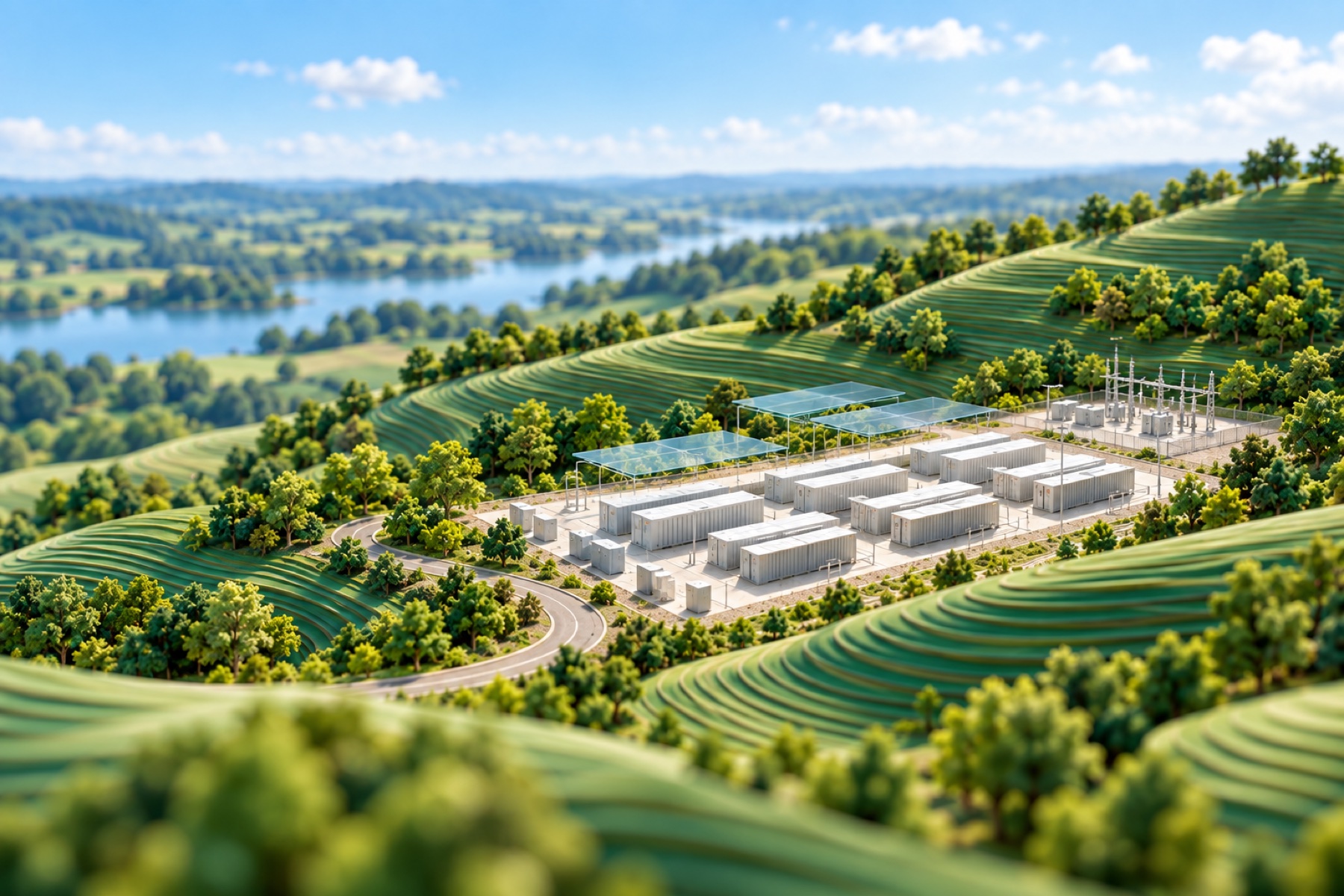
Picture the battery in your phone, then imagine one big enough to power a whole town at once. That giant version is utility-scale battery storage. It works behind the scenes, charging when electricity is cheap or plentiful and sending power back when people need it most. In this guide we’ll break the topic down in simple terms and show why these big batteries are changing the way the grid works.
The quick definition
The U.S. Energy Information Administration calls any battery system that can supply at least one megawatt (MW) of power “utility-scale.” One MW is roughly the peak demand of 750 American homes, so a project that size already packs a punch. Smaller batteries on homes and businesses fall into a different bucket.
Why the buzz is growing
Just five years ago the country had only a handful of large batteries. By mid-2024, operators reported more than 20 gigawatts (GW) online, and developers plan to push total capacity past 30 GW by the end of 2025. Texas and California alone make up well over half of today’s pipeline thanks to their booming wind and solar fleets.
How the big batteries work
Charge: Power electronics draw electricity from the grid or a nearby wind or solar plant and send it into battery packs.
Store: The packs hold that energy for anywhere from two to ten hours.
Discharge: Inverters flip the direct current inside the packs into grid-friendly alternating current and push it back out through a substation.
The whole process is managed by software that watches electricity prices and grid needs in real time, deciding the best moments to charge or discharge.
What are they made of?
Lithium-ion leads the pack. Two chemistries dominate: nickel-manganese-cobalt (NMC) and lithium-iron-phosphate (LFP). Since 2022 LFP has pulled ahead because it costs less and is less prone to overheating.
Other ideas are rising. Flow batteries store energy in liquid tanks, and sodium-ion cells promise cheaper raw materials. These options are still early, but testing is under way.
Jobs the batteries do
Energy arbitrage: Buy low, sell high. Utilities charge the battery when prices dip—often at noon when solar floods the grid—and sell power back at dinner time. Arbitrage is now the primary use for more than 10 GW of U.S. capacity.
Grid stability: Batteries respond in fractions of a second to tiny changes in grid frequency, keeping lights steady.
Capacity insurance: During heat waves or cold snaps the grid operator can call on stored energy to prevent blackouts.
Renewable firming: Pairing a four-hour battery with a solar farm lets the plant keep delivering power after sunset, smoothing the solar curve.
Black-start help: After a major outage, batteries can jump-start bigger generators that need an initial kick of electricity.
Most projects stack several of these services so the same battery earns money in different ways every day.
How much do they cost?
Prices have fallen fast. The average U.S. project price plunged from about $2,150 per kilowatt-hour (kWh) in 2015 to $625/kWh in 2018—a 70 percent drop in only three years. Recent research by the National Renewable Energy Laboratory puts the full installed price of a modern four-hour system at roughly $334/kWh in 2024.The learning curve is still sliding, and analysts expect capital costs to drop another 20 to 30 percent by 2030.
A real-world giant
In June 2025 California regulators approved the Darden Clean Energy Project, which will pair a record-setting 4,600 MW battery with 1.1 GW of solar panels. When finished the system will power about 850,000 homes for four hours each evening, turning old farmland in Fresno County into a clean-energy hub.
Why utilities love them
Speed: Batteries go from idea to operation in a few years, quicker than gas turbines or dams.
Modularity: Developers can add capacity in 5 MW chunks instead of betting on a single massive power plant.
No smoke: Batteries produce zero direct emissions and need no water for cooling, which helps states meet climate and drought goals.
Flexibility: They can be built right next to solar farms, at urban substations, or even on the site of old coal plants.
Challenges to watch
Supply chain strain: Demand for lithium and other minerals is intense. Recycling programs and alternative chemistries aim to ease the crunch.
Duration limits: Four-hour packs cover the evening peak but not multiday wind lulls. Long-duration technologies will be key as renewables grow.
Policy wrinkles: Rules on how batteries can bid into energy markets vary by region, and revenue models are still evolving.
The road ahead
Engineers, investors, and regulators now treat utility-scale batteries as a core piece of the modern grid, not a fringe technology. Cost declines, flexible software, and new chemistries promise wider adoption each year. As electric cars, heat pumps, and data centers push demand higher, grid operators will lean on large batteries to keep power reliable and affordable. For many communities the quiet box outside the substation won’t look like much, but it could be the hero keeping the lights on when the sun goes down.
Sources
U.S. Energy Information Administration, Energy Storage for Electricity Generation (utility-scale means systems ≥ 1 MW) (EIA)
EIA Today in Energy, “U.S. battery storage capacity will increase significantly by 2025” (growth to 30 GW, CA & TX leaders) (EIA)
EIA Today in Energy, “Utilities report batteries are most commonly used for arbitrage and grid stability” (10,487 MW arbitrage) (EIA)
NREL Annual Technology Baseline 2024 (shift to LFP chemistry) (ATB)
NREL, Cost Projections for Utility-Scale Battery Storage: 2025 Update (2024 cost ≈ $334/kWh) (NREL Docs)
EIA Today in Energy, “Utility-scale battery storage costs decreased nearly 70 percent between 2015 and 2018” (EIA)
pv magazine USA, “Largest battery storage project wins fast-track approval in California” (Darden project details) (pv magazine USA)