
Start with the exact property and the amended rules
This page concerns the Town of Mayfield in Fulton County, New York. Establish whether the property is governed by the Town or the separate Village before relying on a zoning description. A Mayfield mailing address alone is not enough to settle that question.
The Town lists a 2025 large-scale battery law and a 2026 amendment alongside older moratorium entries. The base law places its special-use route in Agriculture District 2 and addresses soils and surrounding uses. Confirm the current district and applicable process with the reviewing office for the actual property.
The amendment’s filing cover identifies Local Law 1 of 2026, filed July 13, 2026. Its attached text retains different 2025 labels. Request the current consolidated requirements from the Town, keeping both posted documents available. The amendment changes a listed setback reference from aquifers to lakes and revises the water-source provision; it does not replace the entire battery law.
Code Enforcement links a map labeled 2022. The map notes approximate features and contains blank amendment and signature fields. Use it to begin a location discussion, then confirm the current governing map and property classification. It cannot substitute for a survey or a decision on the proposal.
Reference: Town of Mayfield: adopted local-law directory · Town of Mayfield: filed 2025 large-scale battery law · Town of Mayfield: filed 2026 battery-law amendment · Town of Mayfield: Code Enforcement and application resources · Town of Mayfield: posted zoning map labeled 2022
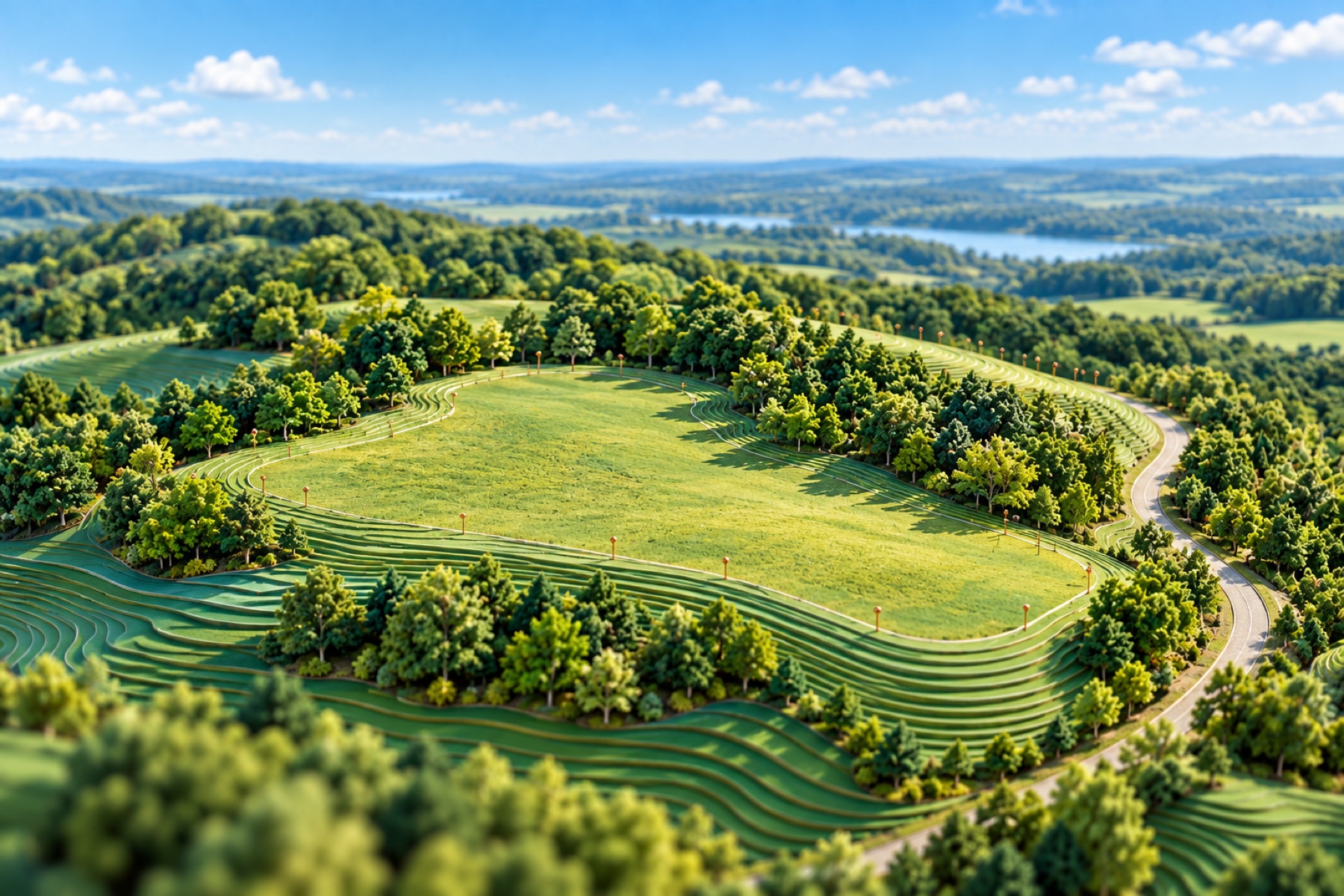
Draw the full area affected by the offer
Have the company outline the equipment site and every other area it wants to use or restrict. A fenced battery area, construction staging area, permanent road and cable route can have different boundaries and durations. Ask which of those areas are included in the payment being discussed.
Show your home, fields, livestock areas, roads and the land you want to retain on the same drawing. Ask the design team to explain how the proposal relates to those uses. Do not accept an acreage estimate that omits land where the agreement would limit your activities.
Consider what you may want to do later. Could you build a barn, move an animal enclosure, plant a different field or divide retained land? Ask the company to identify any proposed restriction on those changes and explain why it needs it. Have your adviser compare that explanation with the actual language.
A preliminary drawing will change as a project is studied. Ask how changes to the occupied area or rights would be agreed and priced. Discuss whether the company could expand them without another signature, and what happens if the project needs more land than you intended to offer.
| Area or right | Question to ask |
|---|---|
| Battery equipment | What land is occupied permanently? |
| Surrounding land | Which uses would be limited? |
| Construction staging | When is this area returned? |
| Road and cable route | Who can use and maintain it? |
| Water source | What access or works are requested? |
Clarify the proposed water source before granting rights
The 2026 amendment calls for an appropriately sized water source for mitigation measures. Ask the project team what it proposes, who has reviewed it and what property rights it needs. The posted wording does not by itself establish that you must provide an existing pond, well or other resource.
If the company wants a new installation on your land, ask who pays to build it, who maintains it and who would own it. Identify any route, pipe, power supply or other works proposed beyond the equipment site. Include those works in the drawing and the agreement discussion.
If an existing source is proposed, explain your present use of it. Would you retain that use, and how would competing needs be addressed? Ask who may enter to inspect or maintain the source and how you would be notified. Do not assume an existing land lease already answers these questions.
Discuss the end of the arrangement as well as the beginning. Would the source and associated works be removed, left for you or used by another project? Ask what condition would be required if you keep them and which party would be responsible for repairs before handover.
Reference: Town of Mayfield: filed 2026 battery-law amendment
Want to ask about your land?
Send the location and what you know. You don’t need a project plan.
Tell us about your landKeep screening, working access and retained land connected
The base law treats screening, a fire buffer and emergency access separately. Ask the design team to show how its proposed layout addresses all three. A landscape illustration can help explain appearance, but the project drawing must identify the land needed for each purpose.
Discuss what would happen to existing trees and vegetation on your property. Ask which areas would be cleared, which would be planted and who would maintain them. If you value a particular wooded edge or rely on it for privacy, raise that before the company prices or reserves the site.
Trace the route from the public road to the proposed equipment and water source. Identify gates, shared driveways and the way you reach retained land. Ask which vehicles would use the route during construction and operation, and who would repair damage caused by their work.
A new road may change drainage or divide an area you use now. Ask for a clear explanation of crossings, grading and upkeep. Tell the company about seasonal access problems or water movement you have observed; those details can change the questions the project team needs to investigate.
Reference: Town of Mayfield: filed 2025 large-scale battery law
Ask about removal and cleanup as separate obligations
The 2025 law calls for distinct decommissioning and environmental-cleanup surety bonds. For the actual proposal, request the funding documents and the work each covers. Public requirements and the protections offered to you in a private agreement need to be compared.
Ordinary removal and repair after an incident can involve different work. Ask who is responsible under your agreement for each, how that responsibility continues after a transfer, and what evidence of financial protection you would receive. Have your adviser explain who can claim against each instrument.
Describe the condition you expect when the land is returned. Include battery foundations, underground works, roads, the proposed water installation and disturbed soil. If you want to keep an improvement, discuss that explicitly rather than leaving its ownership or maintenance uncertain.
Ask how the company will demonstrate completion. Who checks the work, how are unresolved items handled, and when would any payment or restriction end? An equipment removal date alone may not answer when you can resume using the land as intended.
Reference: Town of Mayfield: filed 2025 large-scale battery law
Distinguish a land discussion from a project determination
Ask for evidence supporting the proposed connection as well as the land layout. Identify the project’s utility contact, study status and outstanding work. A nearby line or substation can be a starting point for investigation, but it does not establish an available connection for this proposal.
The Town’s resources include an Adirondack Park Agency inquiry form for obtaining a written jurisdictional determination. The form distinguishes an inquiry from an application. Where that question arises, establish the property’s location and project details before assuming an agency review is or is not needed.
Be clear about who is authorized to act for you. Reading a form or discussing a property is different from signing an inquiry, authorizing representation or making an application. Ask the company to explain any authorization it requests and have your adviser review its scope.
Compare proposed payments with the rights, timing and unresolved conditions. Identify what is paid while the company investigates, what triggers construction or operating payments and how long the land can remain committed if approvals or connection work do not progress.
Reference: Town-posted Adirondack Park Agency jurisdictional inquiry form
Send the location and the land uses you want to preserve
Begin with your contact information in the form, followed by the property location. New York and Fulton County are selected here and can be changed. Acreage and parcel number are optional; an identifiable location is a useful starting point if those details are not handy.
Mention any offer you have received, whether it involves a lease or sale, and which part of the land you would consider. Tell us about access, farming, trees or water uses that you want to preserve. These details help keep the discussion tied to your property.
An inquiry to Sunland does not reserve the land or authorize a filing. Further discussion depends on the actual project, applicable review, connection evidence and acceptable commercial terms. You can start the conversation without having a complete development package.
Questions landowners ask
Is the battery footprint the only land affected?
Not necessarily. Ask for all occupied areas and proposed restrictions, including access, cables, landscaping and any water-source rights. Compare the drawing with the agreement.
Does the Town’s water-source wording require me to offer my pond?
It does not establish that owner obligation by itself. Ask what source the project proposes and what rights it wants from you.
Should I rely on the posted map to establish my zoning?
Use the map to start the discussion, then confirm the current district and governing map for the property with the Town. The posted map includes limitations and blank amendment fields.
Does removal funding also answer environmental cleanup questions?
Request both sets of documents and compare their coverage with the private agreement. Do not assume they cover the same work or give you the same rights.
Do I need acreage or a parcel number to contact Sunland?
No. Start with your contact details and the property location. The optional details can follow.
Sources & further reading
Sources checked 2026-10-07. Local rules and program details can change. Check the requirements for the actual project.
- Town of Mayfield: adopted local-law directory
- Town of Mayfield: filed 2025 large-scale battery law
- Town of Mayfield: filed 2026 battery-law amendment
- Town of Mayfield: Code Enforcement and application resources
- Town of Mayfield: posted zoning map labeled 2022
- Town-posted Adirondack Park Agency jurisdictional inquiry form